Friday, 13 May 2016

To seek Cabinet nod for India Post payment bank this month:
Ravi Shankar Prasad


The Ministry of Communications and Information Technology has moved a Cabinet note on India Post’s payment bank proposal and is likely to seek the approval of the Union Cabinet this month. India Post’s payment bank is slated for a March 2017 launch.

“The postal department’s payment bank will be a game changer for financial inclusion. Several international and national consortiums for third party services are keen to partner with us. Deutsche Bank, Citi Bank, Barclays, Templeton and all the banks of India and all mutual funds and insurance companies, except LIC, for third party delivery, are willing to partner,” Minister of Communications and Information Technology Ravi Shankar Prasad told The Indian Express.

The domestic players in the fray for partnering India Post include NABARD, HSBC, Allahabad Bank, Indian Overseas Bank, Kotak Life Insurance, HDFC, PNB Metlife, ICICI Lombard, ICICI Prudential, and Bajaj Allianz, while the international ones, apart from Deutsche Bank, Barclays, Citi and Templeton, include Transport USA for renting solutions, Western Union, ClearSecurity and Japan’s Hitachi.

These companies have approached the postal department for partnering on banking products, banking solutions, consultancy, banking correspondents, physical security products, ATMs and digital payment services. In August 2015, the Reserve Bank of India had granted in-principle approval to 11 applicants to set up payments banks, including India Post.

On Wednesday, the officials of the postal department apprised Prasad of the situation on its payment bank. As a prerequisite, Prasad said: “I have noted that the personnel must be properly trained to use the infrastructure,” he said. He also said that the India Post was in process of modernising its infrastructure to suit the growing needs of its customers. He informed that the department had 913 automated teller machines (ATMs) currently, against only four in 2014.

As of date, Prasad said, 20,644 post offices were enabled with core-banking solutions (CBS), against 230 as of June 2014. CBS-enabled post offices allow customers to access their postal savings from any of the branches where the facility is available.

Implementation of CBS is part of the government’s plan for IT Modernisation Project of the Department of Posts, which aims to bring in various IT solutions with the required infrastructure to the post offices.


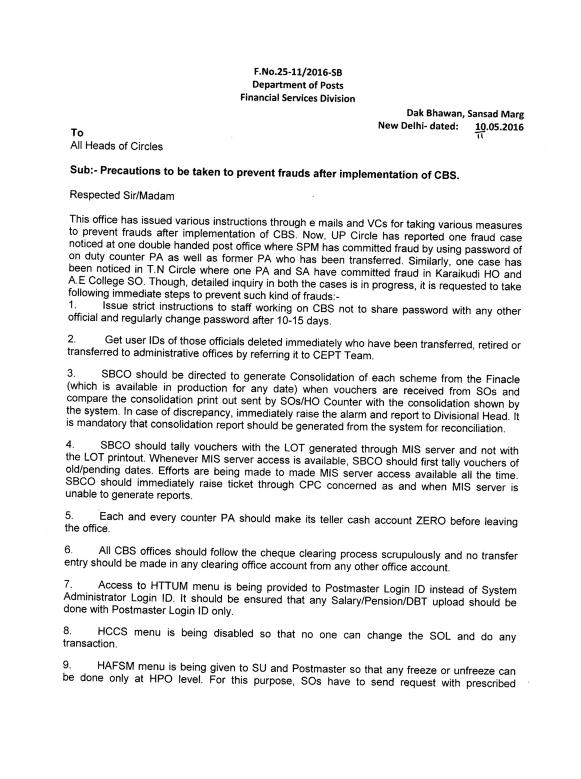
PRECAUTIONS TO BE TAKEN TO PREVENT FRAUDS AFTER IMPLEMENTATION OF CBS.


Tuesday, 10 May 2016

AIPSBCOEA (CHQ) - BULLETIN NO. 6
NEED BASED MINIMUM WAGE STILL APPEARS A DREAM FOR WORKING CLASS EVEN AFTER 68 YEARS OF INDEPENDENCE OF INDIA – NO COMPROMISE ON RETROGRADE REPORT OF 7th CPC, STAND FOR STRUGGLE KEEP HIGHER


Confrontation will become inevitable if unilateral orders are issued on 7th CPC implementation: Confederation

It seems that Modi Govt. is not in favour of a negotiated settlement on the 7th CPC related issues with the staff side. The Seventh CPC report was submitted on 19th November 2015. Six months are almost over since then. Till date the Govt. has not come forward for a negotiated settlement. Instead, Empowered Committee of Secretaries (ECoS) headed by Cabinet Secretary conducted a meeting with the staff side on 1st March 2016. In the meeting Govt. did not disclose its mind on any of the demands raised by the staff side in the charter of demands submitted to Govt. Staff side explained the justification for each demand but official side didn’t make any comment, either positive or negative. The concluding paragraph of the minutes of the meeting reads as follows:

“After hearing the participants, Cabinet Secretary observed that the deliberations have helped ECoS in understanding the major concerns of the staff side and said that all issues have been taken note of. He assured that fair consideration will be given to all points brought out by JCM before taking final views. He further stated that the ECoS needs to examine the Report of the Commission in entirety as well as the issues raised by JCM in consultation with all other stake holders. As such, it may take some time to take a final call on the recommendations of the Commission.”
It may be seen that, neither did the Govt. side made any commitment on any demands, nor did they indicate in the minutes that further discussion will be held with the staff side to arrive at a negotiated settlement on each demands. It seems that the Modi Govt is moving ahead to issue unilateral orders taking the staff side for a ride.

The JCM staff side Secretary, in his letter dated 2nd May 2016, addressed to Cabinet Secretary, has made the stand of the staff side clear, without any ambiguity. The letter reads as follows:

“I have been directed to draw your attention towards minutes of the Standing Committee of National Council JCM held on 7th May 2008 and our rejoinder submitted to Govt. in the matter of Report of 6th CPC.

You will kindly find that it was not only a general discussion, but also official side explained their views on each and every issue.
I would therefore request your good self to kindly arrange for similar type of meeting for bi-lateral settlement on each of the issues raised by the staff side, NC/JCM before the Empowered Committee of Secretaries.”
Thus the picture is clear now. The Govt, it seems, has a hidden agenda to take the staff side for granted without giving any further opportunity for a negotiated settlement. The staff side on the other hand has taken a position that if unilateral orders are issued, without taking the staff side into confidence, the NJCA shall go ahead with the indefinite strike from 11th July 2016 as already informed to the Govt. Employees have faith in the NJCA and they believe that the NJCA leadership shall assert itself and shall not compromise on major demands.

The coming days are crucial. If the Govt. adopts delaying tactics or issue unilateral orders rejecting our demands, then confrontation shall become inevitable. The stand taken by the then Nehru Govt. that “Pay Commission report is an award and is not negotiable” has resulted in the historic indefinite strike of 1960, which commenced on July 11th midnight.

The NJCA leadership should be ready for a showdown, if Modi Govt refuse to arrive at a negotiated settlement with the staff side as demanded by Secretary, JCM(NC) staff side.


M KRISHNAN
Secretary General
Confederation


Friday, 29 April 2016

SHRI S. K. SINHA WILL TAKE OVER AS


DIRECTOR GENERAL, DEPARTMENT OF POST


NOW THE BALL IS IN THE GOVT’S COURT LET US BE READY
FOR INDEFINITE STRIKE

          Seventh Central Pay Commission has submitted its recommendations to Government on 19-11-2015.  As most of the recommendations are retrograde and far below the expectations of the employees, the JCM National Council Staff side under the united banner of National Joint Council of Action (NJCA) strongly protested and demanded modification of the retrograde recommendations.  It further decided to organise indefinite strike and letter conveying the decision was sent to the Cabinet Secretary.

                   Main demands raised by NJCA are: (1) minimum wage of Rs.26,000/- as against 18000 recommended by CPC, (2) upward revision of the fitment formula and application of the same in all pay scales in the pay matrix, (3) retention of percentage of HRA as 30%, 20% and 10% as against 24%, 16% and 8% recommended by CPC.  (4) recommendation of the CPC to abolish important allowances should be rejected, (5)  reject recommendations to discontinue all non-interest bearing advances, (6) reject the recommendation to reduce the salary to 80% for the second year of child care leave, (7) reject recommendations to impose more stringent conditions on MACP scheme such as “very good” benchmark, qualifying examination, re-introduction of efficiency bar etc. (8) modification in the parity-in-pension and acceptance of other minimum demands of pensioners and (9) Grant of Civil Servants Status to Gramin Dak Sevaks and extending all the benefits of departmental employees to Gramin Dak Sevaks on pro-rata basis.  There are other demands also which are equally important.

                   Govt. constituted an Implementation Cell in the Finance Ministry to study the recommendations and submit its proposal to the Empowered Committee of Secretaries under the Chairmanship of Cabinet Secretary.  Empowered Committee will submit final concrete proposals to Cabinet for approval.  On receipt of the letter of NJCA addresed to Cabinet Secretary regarding indefinite strike, the Implementation Cell called the JCM staff side leaders to present its view points before the cell. Accordingly the NJCA leaders met the Convenor of Implementation Cell and explained the justification of each demands in the charter of demands.

                   NJCA decided to give strike notice on 11th March 2016 to commence the indefinite strike from 11th April 2016.  At this stage the Cabinet Secretary invited the JCM National Council staff side leaders for discussion with Empowered Committee of Secretaries on 1st March 2016.  The NJCA leaders attended the discussion and once again explained the justification of all demands before the Empowered Committee.  Cabinet Secretary gave a patient hearing but made no commitment on any of the demands. He finally appealed the staff side to give some more time for the Government for inter-departmental consultations and to take a final view and decision on ech demand raised by the staff side in the charter of demands.

                   NJCA met and reviewed the whole situation and came to the conclusion that as the Government has appealed for some more time to take a decision, it will be appropriate on the part of the staff side to give time to the Government, so that later on Government cannot blame that NJCA went on sudden strike inspite of the appeal from the Government to give some more time.  Secondly, Railways and Defence departments come under the purview of Industrial Dispute Act and as per the ID Act, if strike notice is served on 11th March 2016, strike should commence within six weeks from the date of serving notice, by which time the election in four states will not be over.  Thirdly, as the Assembly elections in four states have been notified and election code of conduct has come into force, the employees of four states will find it difficult to join the strike as many of them will be drafted for election duty.  Taking into consideration all the above aspects, the NJCA decided to defer the indefinite strike from April 11th to July 11th and to serve the strike notice on June 9th instead of March 11th.

                   Now the ball is in the Govt.’s court.  Before June 9th, ie. date of serving strike notice, the Government will be getting seven month time from the date of submission of the 7th CPC report, to take a final decision on all the demands and also to come to a negotiated settlement with the staff side.  Any further delay is unwarranted and unjustified and cannot be tolerated.  If the Government take an adamant stand and reject the justified demands of the staff side, then we will be forced to serve notice for indefinite strike from July 11th.  Government cannot take the staff side for granted.


            AIPEU Group-C CHQ appeals to all the constituents of NJCA to take a firm stand and not to compromise on minimum demands.  Let us also pledge that we will be second to none, in organising the indefinite strike in Postal and ensure cent per cent participation of our membership at gross root level in the impending 

Monday, 25 April 2016

Govt likely to implement 7th Pay Commission award around September-October

New Delhi: The Central government employees will have to wait till September-October to get higher salaries under the 7th Pay Commission.


As per a Financial Express report, government is expecting that higher salaries released around the festival period starting with Durga Puja and Diwali will boost consumption, which will have a multiplier effect on the economy. 

Though the employees will get arrears with retrospective effect from January 1, no retrospective arrears in allowances will be given. With the move, the exchequer would be able to save around Rs 11,000 crore. 

The commission had estimated the additional outgo in FY17 due to its award at R73,650 crore.


Source: http://zeenews.india.com